Mas allá de nuestro Horizonte!

Existe alguna otra civilización en el vasto espacio, aparte de los seres humanos en la Tierra? (Sin importar su apariencia)?
La pregunta de si existen otras civilizaciones en el cosmos es una de las más profundas y debatidas en la ciencia.
Tenemos algunas respuestas científicas, pero la duda persiste, ¿es esa toda la verdad?

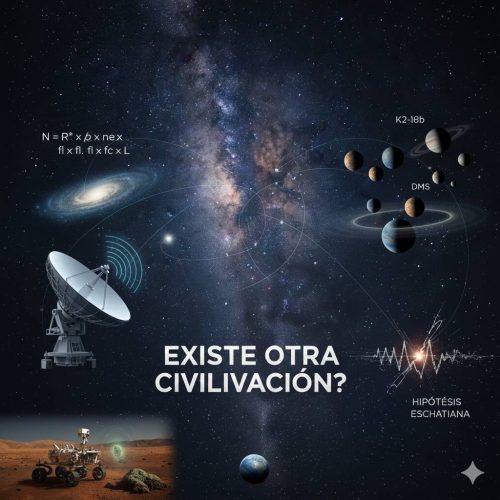
  • Paradoja de Fermi: Esta paradoja plantea la pregunta: “Si hay tantas civilizaciones potenciales allá afuera, ¿por qué no hemos visto ninguna evidencia de ellas?”. A pesar de la inmensidad del universo, no se ha encontrado evidencia definitiva de civilizaciones extraterrestres.
  • Ecuación de Drake: Formulada por Frank Drake, esta ecuación intenta estimar el número de civilizaciones extraterrestres activas y comunicativas en la galaxia de la Vía Láctea. Involucra factores como la tasa de formación de estrellas, la fracción de esas estrellas con planetas, etc. Sin embargo, muchos de estos factores siguen siendo especulativos.
  • SETI (Búsqueda de Inteligencia Extraterrestre): Organizaciones como SETI han estado escaneando los cielos en busca de señales de civilizaciones extraterrestres. Hasta ahora, no se han detectado señales confirmadas de vida inteligente, pero la búsqueda continúa con tecnologías cada vez más avanzadas.
  • Exoplanetas: Hemos descubierto miles de exoplanetas, algunos dentro de la zona habitable de su estrella (donde las condiciones podrían permitir la vida tal como la conocemos). Esto aumenta la probabilidad estadística de que exista vida en otros lugares, pero no lo confirma.
  • Astrobiología: Los estudios en este campo buscan signos de vida más allá de la Tierra, incluyendo vida microbiana en otros planetas o lunas dentro de nuestro sistema solar. Aún no se ha encontrado evidencia definitiva de vida extraterrestre.
  • Consideraciones Filosóficas y Científicas: Muchos científicos creen que, dada la escala del universo, la vida (y posiblemente la vida inteligente) debería existir en algún otro lugar. Sin embargo, las vastas distancias y las escalas de tiempo involucradas (las civilizaciones podrían haber vivido y haberse extinguido mucho antes o después de nuestro tiempo) complican su detección.

Datos Recientes:

  1. Marte y Biofirmas: El rover Perseverance ha detectado recientemente señales potenciales de “reacciones redox” en Marte que podrían ser de origen biológico, aunque los científicos mantienen la cautela mientras esperan traer las muestras a la Tierra.
  2. K2-18b y el James Webb: Se han realizado análisis profundos en este exoplaneta lejano buscando sulfuro de dimetilo (DMS), un gas que en la Tierra solo producen organismos vivos. Aunque los datos son prometedores, aún no se consideran una prueba definitiva.
  3. Hipótesis Eschatiana: En diciembre de 2025, ha ganado fuerza una nueva teoría que sugiere que nuestra primera detección de una civilización alienígena probablemente no sea un mensaje de saludo, sino una señal caótica de una sociedad en crisis o en su etapa final (“ruidosa”).

Aunque no hay evidencia concreta de otras civilizaciones, la probabilidad basada en la enorme cantidad de estrellas y planetas sugiere que podría haber vida en otros lugares. Sin embargo, sin evidencia directa, esto sigue siendo especulativo.

“The world, as it is, is unbearable. Therefore, I need the moon, or happiness, or immortality, something which might be crazy, but is from another world.”

“The world, as it is, is unbearable. Therefore, I need the moon, or happiness, or immortality, something which might be crazy, but is from another world.”
Said by the character Caligula, the omnipotent ruler of ancient world, Emperor of Rome, in Albert Camus’s play of the same name.

“The world, as it is, is unbearable,” his powerful quote reflects the existential despair, the profound sense of disillusionment and the rejection of the absurd nature of human existence as he perceives it. He’s expressing a deep dissatisfaction with reality. He finds the human condition, with its limitations, suffering, banality, to be intolerable. As an emperor, he had immense power and wealth, yet even that couldn’t alleviate this inner torment.

The second part of the quote “Therefore, I need the moon, or happiness, or immortality, something which might be crazy, but is from another world” reveals his desperate longing for transcendence to “Another World” in search of qualities or states of being that are beyond the confines of ordinary human experience and the earthly realm.

“The moon” here symbolizes something divine, perfectly beautiful and pure something untouched by earthly imperfections. It represents an escape from the mundane and the flawed.

“Happiness” a state of perfect and lasting bliss that the “unbearable” world cannot provide. This suggests the search for supreme satisfaction that transcends earthly limitations.

“Immortality” This points to the desire to escape the most fundamental limitation of human existence: death. It is a rejection of finite life and its inherent decay and impermanence.

“Something which might be crazy, but is from another world” This acknowledges the irrationality of his desires from a conventional perspective. He knows these are not things one can simply acquire in this world, yet his need for them is so strong that he yearns for a reality where such things are possible. It’s a plea for a different order of existence, one that offers ultimate perfection, joy, or eternal being.

In essence, Caligula expresses the feeling that this world is not enough for him. He’s not just bored or sad; he considers the very essence of reality to be insufficient, flawed, and restrictive. He yearns for something absolute and perfect, something that lies beyond the material and the mortal. It’s a cry for a transcendent meaning or experience that the “unbearable” world cannot provide, which leads him to seek it in the realm of the impossible or the divine.
It is a sad feeling that resonates with many who feel a deep sense of dissatisfaction with the limitations and imperfections of life as we know it